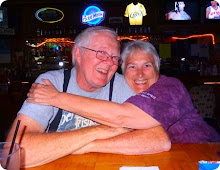
I haven't posted for a few days because we haven't done too much. I didn't realize that the rain could come down so hard in the desert. And the wind just about blew us across the park the other night. Today was a little sunnier but not a lot warmer. I want the 80 degrees back from last week and it's not going to happen for awhile.
I've also been working on tax returns which is time consuming. Besides depressing. Brings back all those memories of that four letter word "WORK!"
Still lovin this retirement thing. Everybody needs to try it.
Wednesday, February 11, 2009

Thursday, February 5, 2009
THE MANY MOODS OF THE SUPERSTITIONS
 Over the last week we had the opportunity to capture the Superstitions in many different moods. Hope you enjoy them as much as we have.
 Warm sunny days.
 Angry rain clouds.
 Beautiful cloud toppings.
 Sun kissed after the rain.
TORTILLA FLAT, AZ
Isn't this a great name?  Tortilla Flat is Arizona's smallest official community having a U.S. Post office and voter'sprecinct.The town has a population of 6. And it has a fascinating history.

 Tortilla Flat got it's name from a John Cline. He and some other folks either went to Phoenix for supplies or on a cattle drive (depending on which legend you believe) and partied too much. So they forgot to buy the supplies they needed after selling the cattle. On their way back to the Tonto Basin they ran out of food except for flour, so they mad tortillas to eat and Mr. Cline christened the flat area, Tortilla Flat. (This was probably in about 1886).
 Tortilla Flat (the town) got its start because of the road construction to Roosevelt Dam in 1904. It is the last remaining stage coach stop along the Apache Trail.
 Tortilla Flat is Arizona's smallest official community having a U.S. Post office and voter'sprecinct.The town has a population of 6. And it has a fascinating history.
In the beginning - Tortilla Flat was a small grassy valley in the Superstition Mountains. Because of its location Tortilla Flat was affected by the search for gold in the Superstitons especially by the Spaniards during the late 1600s and early 1700s. During this time the Jesuit Priests had amassed a fortune in gold and didn't want to share it with the King of Spain. So according to legend, the Superstition Mountain region was where they hid their treasures.

 Tortilla Flat got it's name from a John Cline. He and some other folks either went to Phoenix for supplies or on a cattle drive (depending on which legend you believe) and partied too much. So they forgot to buy the supplies they needed after selling the cattle. On their way back to the Tonto Basin they ran out of food except for flour, so they mad tortillas to eat and Mr. Cline christened the flat area, Tortilla Flat. (This was probably in about 1886).
 Tortilla Flat (the town) got its start because of the road construction to Roosevelt Dam in 1904. It is the last remaining stage coach stop along the Apache Trail.
 MORE CANYON LAKE

This lake is so  beautiful and Jim took such great
  pictures that I wanted to share a few more with you.
 beautiful and Jim took such great
  pictures that I wanted to share a few more with you.
Tuesday, February 3, 2009
APACHE TRAIL & CANYON LAKE, AZ
 WOW! Canyon Lake is one of the four lakes created by dams on
  the Salt River and is reached by following the Apache Trail (Rte 88)
  out of Apache Junction. The Apache Trail shadows the ancient footpaths of Apache Indians and is American's oldest roadway. The Apache Trail is the only reocgnized Historic and Scenic Highway in Arizona. The road was originally built as a haul and service road for the construction and maintenance of Roosevelt Dam. The trail begins with paved roads that soon turn into narrow dirt roads that meander along a landscape that ranges from rolling desert to high cliffs for 47 miles. The drive is along the backside of the Superstition Mountains where the secrets of the Lost Dutchman's Mine remain hidden. (more about that later)
Sunday, February 1, 2009
PLANTED FOR A MONTH


 We have arrived in Apache Junction where we will be spending the month of February. We're staying at the Desert Holiday RV Resort and we were definitely the entertainment of the evening last night when we were trying to back the RV into our spot. This is a small RV park and they don't allow much room to manuever but thanks to our friendly neighbors, we had six guys helping Jim. (I wanted to take a picure but Jim said he was too busy to give me the camera. I don't think that was the real reason.)
 Jim got the fiver backed in but the truck was at such an angle that the hitch wouldn't release. So the guys helped Jim pull the pins and take the hitch apart so we could get the truck out. This only took about 45 minutes and it gave me a good chance to visit with the wives. Everybody is extremely friendly and I think we're going to enjoy our stay here. As you can see we are hooked up and moved in. And did I happen to mention how beautiful the weather is.
HOW ABOUT SOME LAS VEGAS HISTORY
History tells us that the first tourist to Las Vegas was Rafael Rivera, who came along in the early 1700s. During the early part of the 18th century, Spanish explorers looked on the journey through this part of the West as the "Jomada de muerte" or journey of death, for the high summer temperatures and dry desert conditions during almost any time of the year. Rafael Rivera was a young scout and is considered the first European to gaze upon the valley. He saw wild grasses and trees and therefore a supply of water, from the natural springs in the valley. However, this wasn't news to the Palutes (or the Anasazis who came before them), who had dwelled in the region for centuries.
Inspired by the green vegetation in the midst of the desert, they named it las vegas, Spanish for "the meadows." The Spanish explorers and missionaries who quickly followed them established the Spanish Trail by about 1829. Parts of this trail eventually became what we know as Interstate 15.
The tradition of the beer in one hand and a bucket of quarters in the other came along later in Vegas history.
Inspired by the green vegetation in the midst of the desert, they named it las vegas, Spanish for "the meadows." The Spanish explorers and missionaries who quickly followed them established the Spanish Trail by about 1829. Parts of this trail eventually became what we know as Interstate 15.
The tradition of the beer in one hand and a bucket of quarters in the other came along later in Vegas history.
Subscribe to:
Posts (Atom)